
In the hostile environment of an Ultra-High Vacuum (UHV) chamber, with all of its components, every single one is a potential failure point. For decades, vacuum engineers made much use of ceramic-to-metal seals for electrical connectivity. While effective, ceramics have a major downside, which is brittleness.
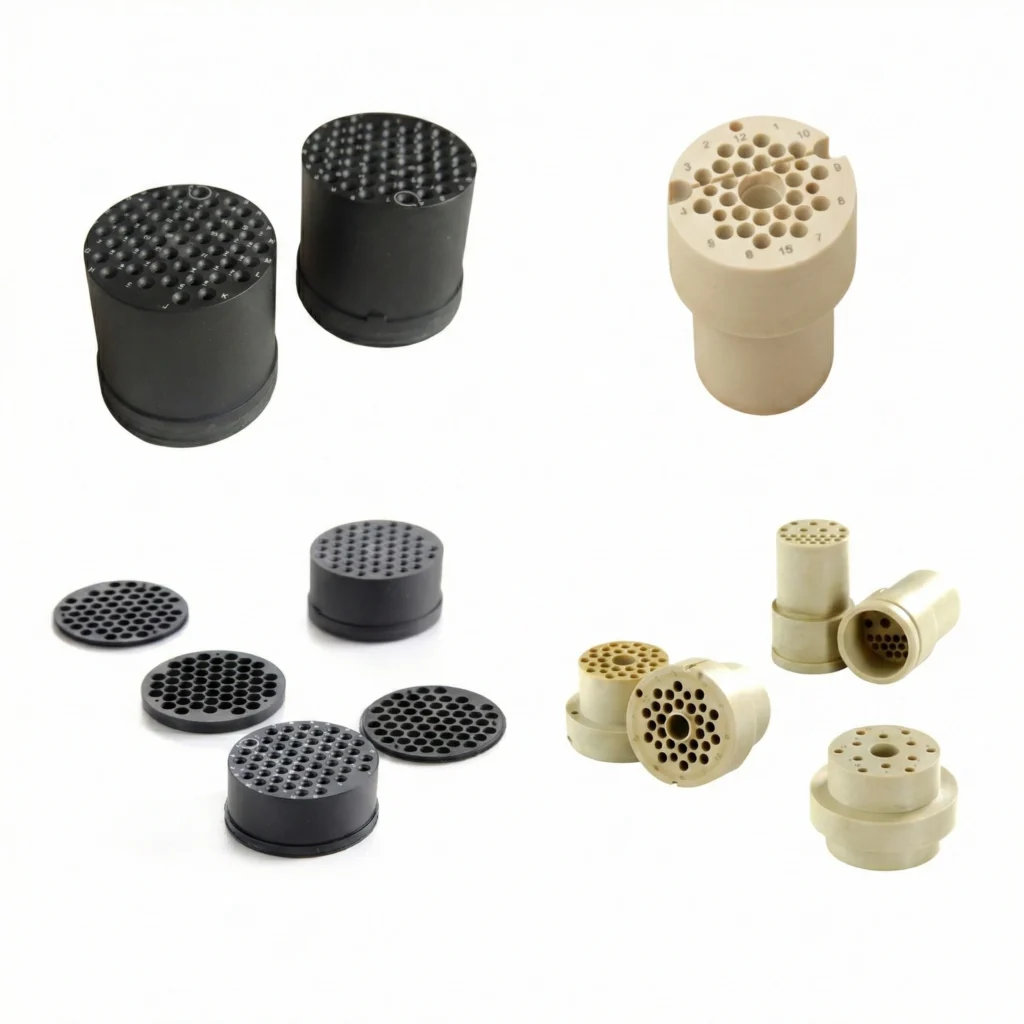
Today, we are witnessing a paradigm change in the manufacturing of semiconductors and surface analyzer equipment. The general trend in the industry is towards PEEK multipin feedthroughs. This high performance thermoplastic is not only a plastic, it is an important engineering solution that solves the “cracked insulator” headache while preserving the vacuum integrity needed for PVD, CVD and particle physics applications.
This article pertains to the technical superiority of PEEK (Polyetheretherketone) in vacuum environments and why it is the superior choice for your next vacuum system design.
The primary criterion for any material inside a vacuum system is its outgassing rate. If a connector releases volatile organic compounds (VOCs) or water vapor under low pressure, it acts as a “virtual leak,” making it impossible to reach UHV levels ($<10^{-9}$ Torr).
PEEK connectors have proven exceptional in this regard. Unlike standard plastics like Nylon or PVC which act like sponges for moisture, PEEK is inherently hydrophobic.
By utilizing high-purity polymer-based interconnects, engineers can pump down faster and maintain deeper vacuums compared to inferior insulators.
This is the most typical search intent for an engineer searching for alternatives: Durability.
Ceramic (Alumina) feedthroughs are excellent electrical insulators, but they are unforgiving. A poor alignment of the flanges when being bolted down or a dropped tool, or thermal shock, can result in catastrophic cracking.
High-performance thermoplastic interfaces have a transparent property that is not found in other materials: Modulus of Elasticity.
PEEK has the mechanical toughness to absorb the stress that would shatter ceramic. This allows for:
To help you make an informed decision, we have compiled a comparison of common materials used in electrical vacuum instrumentation.
| Property | PEEK (Polyetheretherketone) | Ceramic (Alumina) | PTFE (Teflon) |
| Vacuum Compatibility | Excellent (UHV Ready) | Excellent (XHV Ready) | Good (Prone to creep) |
| Impact Resistance | High (Tough) | Low (Very Brittle) | Moderate (Soft) |
| Machinability | Superior (Custom Geometries) | Poor (High Tooling Cost) | Good |
| Dielectric Strength | ~190 kV/cm | ~150 kV/cm | ~60 kV/cm |
| Max Bake-out Temp | 260°C (500°F) | 450°C+ | 200°C |
| Seal Integrity | Consistent | Risk of micro-cracks | Risks “Cold Flow” leak |
Data Source: Based on standard ASTM material properties and internal vacuum testing.
Engineer’s Note: While ceramics hold the edge for extreme temperatures (>300°C), the vast majority of PVD/CVD processes and bake-out cycles occur below 200°C, placing them firmly within PEEK’s “sweet spot.”

Where exactly are these vacuum-compatible headers being used?
Space is very limited in Physical Vapor Deposition tools. High-density transmission of signals monitored by the process without the risk of contaminating the process chamber is possible with custom PEEK headers to the sensors to measure wafer temperature and plasma status.
Beamline diagnostics has a need to have materials that can withstand radiation as well as offer electrical isolation. PEEK has a Gamma resistance (to a maximum of 10 Rads) that has made it common in high-energy physics.
In addition to connectors, PEEK is also the ideal material to use in Chemical Mechanical Polishing (CMP) rings due to its chemical resistance to harsh slurries.
To address common queries regarding vacuum electrical feedthroughs, our engineering team answers:
Answer: Yes. Due to its extremely low outgassing rates and low moisture absorption (ASTM D570 <0.1%), PEEK is fully compatible with UHV environments down to $10^{-10}$ Torr, provided the material is properly cleaned and baked out.
Answer: PEEK has a continuous use temperature of 260°C. Bake-outs of most vacuum systems take place at 120°C to 200 °C to eliminate any water vapor, which fits well within the safe operating range of this polymer.
Answer: Contrary to glass-to-metal seals, PEEK feedthroughs should use high-precision interference fits or dual O-ring designs. Since PEEK is machinable to fine tolerances, it is very well matched with standard CF (ConFlat) or KF flanges to form a helium-tight seal.
The weakness of the conventional brittle materials is increasingly evident as vacuum systems grow more complicated and compact. PEEK Multipin Feedthroughs provide the optimal combination of electrical insulation, mechanical strength and purity of the vacuum.
Be it a new UHV chamber that needs design or that of an existing analysis instrument that needs retrofit, the move towards PEEK will provide the reliability where it counts.
Looking for a custom solution?
We are the Zhejiang BW Industry which is specialised in the production of the high precision PEEK components by CNC machining. We design the connexion you need whether it is putting the pin or the standard replacement.

 English English
  German
 Russian
 Spanish
 French
 Japanese
 Portuguese (Portugal)
 Turkish
 Portuguese (Brazil)