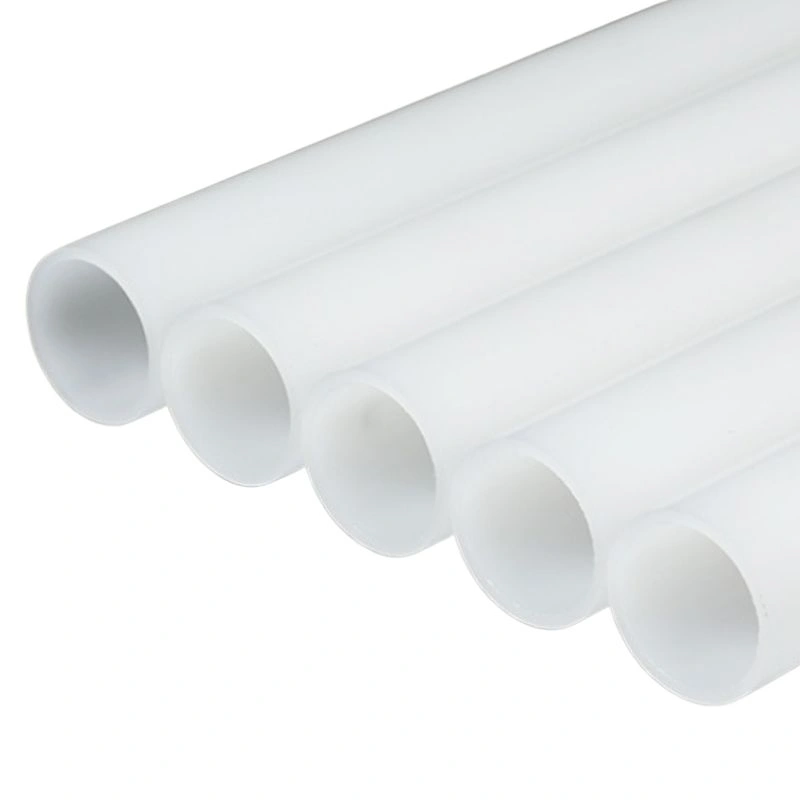

PVDF (polyvinylidene fluoride) is a semi-crystalline fluoropolymer. Compared with PTFE it holds shape better and creeps less; compared with PP it survives harsher chemistries and sun. Typical orientation values (verify against the chosen BWPEEK grade’s TDS):


It doesn't soak up much water, so it stays the same size after you work on it and use it.
It can handle sun and weather for outdoor equipment.
Wet bench carriers, wafer supports, bath edge guards, UPW header brackets, chemical delivery blocks, drain manifolds, overflow weirs.
Stuff that can leach out (extractables/ionics), particles, how well liquids stick to the surface, and keeping gunk from growing in recirculating loops.
It's smooth, resists chemicals, and we know how to rinse and pack it to keep it clean.
Folks often go with Type I (emulsion) because it's easy to keep clean and weld.
Don't make deep holes that are closed at one end. Use holes that go all the way through with caps so they're easier to rinse.
Round off sharp corners. Don't leave any cracks where air can get stuck and release particles.
If you're welding, decide early on which filler rod and plate grade to use, and how the seams should look.
Deburr in a clean room, rinse with deionized water, dry with filtered air, and pack it in two bags to keep it clean.
These include things like jigs for calendaring lines, blocks for aligning coating lines, tray and fixture locators, guards for solvent areas, and structural parts for electrolyte filling stations that don't get wet.
Expect NMP vapor, carbonate solvents, and LiPF₆ electrolyte vapors. Temperatures are usually normal room temp, but can reach 60–80 °C close to machines.
It stands up to most battery solvents and stays stiffer than PTFE, so your alignments hold.
Its low moisture absorption helps keep dimensions consistent.
Don't use thin, unsupported ribs. For guards, go with 4–5 mm thickness; use even more for load-bearing parts.
For threads, use metal inserts if you'll be tightening and loosening them a lot.
Natural color is best. If you need colors, talk about pigment systems to make sure they don't outgas or cause cleanliness issues.
Machine parts dry and wipe with a compatible solvent. Make sure there are no residues that can react with lithium salts.
Check how stable the dimensions are after soaking at the site's temp; keep track of any drift.
If parts are near electrolyte splashes, think about using shields or wear pads that you can swap out quickly.
Analyzer cases, bits of sampling blocks, insides of utility chemical lines, corrosion coupon holders, and pump skid brackets.
Places with acidic stuff, salts, or sour conditions; also where there are splashes, mist, and changing temperatures.
It doesn't corrode in many utility chemical lines and holds up in splash/mist areas where metals tend to pit.
It also keeps electricity from flowing in assemblies made of different metals.
| Material | Chem. Resistance | Temp Ability | Machinability | UV Durability | Typical Trade-Off |
| PVDF | Excellent (many Acids/halogens/solvents) | ~up To 120 °C | Good; Stiffer Than PTFE | Good | Lower Max Temp Than PEEK |
| PTFE | Excellent | Higher | Soft; High Creep | Good | Tight Tolerances Are Harder |
| PP | Moderate | Lower | Good | Fair | Limited Chem/UV Window |
| PEEK | Very Good (by Medium) | Much Higher | Good (harder) | Good | Cost |
PVDF rod from BWPEEK is stock for machining parts that meet corrosive media or cleanliness rules—valve seats, pump pieces, manifolds, wet-bench fixtures, UPW tooling, battery-area jigs.
No. Approval is grade-specific. Ask BWPEEK for the certificate set (e.g., FDA/NSF/KTW/WRAS) for the exact grade and lot.
Different polymerization routes (emulsion vs. suspension) → different purity/processing behavior. BWPEEK recommends Type I for cleanliness-critical fixtures; otherwise select by weldability/surface needs.
Yes—hot-air, IR, or plate welding with compatible grades. Validate parameters and leak-test. BWPEEK supplies matching consumables on request.
Keep tools sharp, evacuate chips, control heat, support slender parts, and soften edges with fillets/chamfers; for high-purity parts, clean and pack to procedure.
With the correct BWPEEK grade and a defined clean-pack protocol, yes. Admission typically requires documents and, if needed, ionics/extractables data.
Yes for tooling/jigs; verify exposure conditions and temperature profile with BWPEEK.
EU-stocked diameters typically ship in 2–4 business days (stock-dependent). BWPEEK offers cut-to-length, CNC, deburring, and clean packaging.
| Diameter (mm) | Length (mm) | Weight (Kg) |
| Φ10 | 1000 | 0.15 |
| Φ20 | 1000 | 0.6 |
| Φ30 | 1000 | 1.3 |
| Φ40 | 1000 | 2.3 |
| Φ50 | 1000 | 3.6 |
| Φ60 | 1000 | 5.2 |
| Φ70 | 1000 | 7.1 |
| Φ80 | 1000 | 9.3 |
| Φ90 | 1000 | 11.8 |
| Φ100 | 1000 | 14.5 |
| Φ110 | 1000 | 17.5 |
| Φ120 | 1000 | 20.9 |
| Φ130 | 1000 | 24.5 |
| Φ140 | 1000 | 28.5 |
| Φ150 | 1000 | 32.7 |
| Φ160 | 1000 | 37.2 |
| Φ180 | 1000 | 47.1 |
| Φ200 | 1000 | 58.1 |
| Φ220 | 1000 | 70.3 |
| Φ250 | 1000 | 90.8 |
| Φ300 | 1000 | 130.7 |


 English English
  German
 Russian
 Spanish
 French
 Japanese
 Portuguese (Portugal)
 Turkish
 Portuguese (Brazil)